Responsible purchasing
Our Fair Labor Principles require participating companies to align their planning and purchasing practices with a commitment to workplace standards
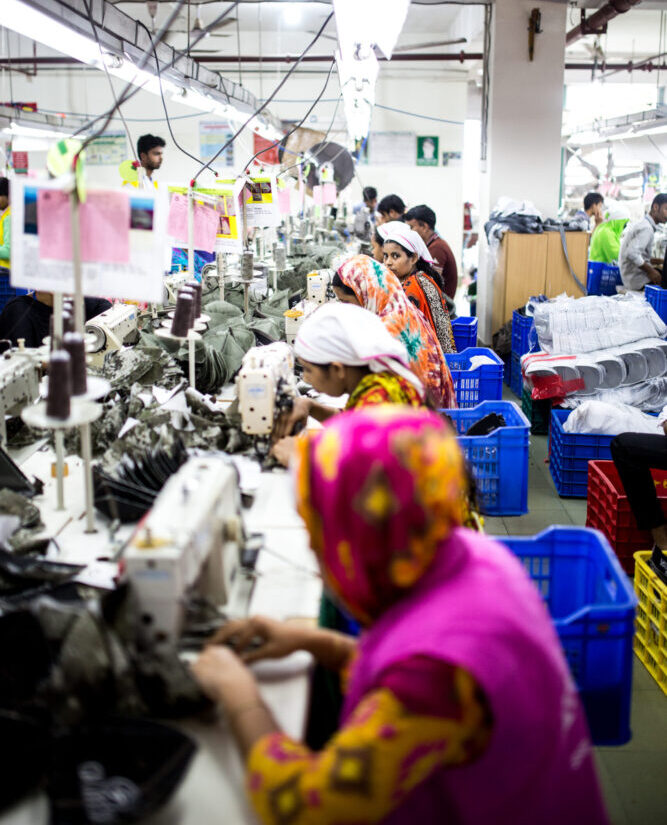
Purchasing practices directly impact the working conditions and livelihoods of workers around the world.
All the business operations that buyers engage in to bring a product to market—from sales and merchandising to product development, planning and forecasting, calendar management, agreement creation, cost negotiations, sourcing, procurement, and payment terms—influence supplier activities, which in turn impact workers.
Without consistent and systematic attention to responsible purchasing, production, and sourcing practices, companies can undermine their factory and farm-level efforts toward ethical working conditions.
Our Fair Labor Principles are rooted in international labor standards and offer companies a pathway to understanding how their purchasing practices influence workplace conditions. We work with the buyers in our network to progressively improve their business practices, building more resilient supply chains and minimizing harm to suppliers, workers, and communities.
Our work in responsible purchasing
The Fair Labor Association has been a leader in responsible purchasing practices (RPP) for 20 years. We were the first organization to create a standard on RPP, requiring companies pursuing Fair Labor Accreditation to align their planning and purchasing practices with a commitment to workplace standards since 2014.
We regularly evaluate our 50+ member companies’ purchasing, production, and sourcing practices against our benchmarks and key performance indicators, which are aligned with the highest international labor standards, to mitigate the risk of negative impacts to human rights or the environment.
We have also developed practical tools and guidance to help lay the foundation for successful buyer-supplier relationships and decent work. In September 2026, we released new guidance offering a three-part simplified framework for buyers in the manufacturing industry to align their business operations with effective human rights due diligence and RPP.
The OECD’s recent Alignment Assessment recognized the strength of our RPP work and standards, finding we have comprehensive requirements for its member companies to consider the impacts of purchasing and production practices, including consideration of wage-related risks and supplier incentives.
Multi-stakeholder collaboration on responsible purchasing practices
In 2025, we began our Principles Revisions process to further strengthen our standards for Fair Labor Accreditation. As part of this process, we’ll be updating Principle Two through FLA’s multi-stakeholder governance structure to reflect recognized progress in standards, including the OECD Due Diligence Guidance for Responsible Business Conduct, the Common Framework for RPP (CFRPP), and the Purchasing Practices Due Diligence Framework (PP-DD Framework).
We helped develop and pilot the PP-DD Framework as part of our work with the Responsible Purchasing Practices Working Group, an industry-wide initiative backed by a number of multi-stakeholder organizations that launched in 2022.
Fair Labor Standards: Responsible purchasing
Successful implementation of Principle Two is the bedrock of a robust and effective social compliance program.
Responsible sourcing for manufacturing: Benchmarks and KPIs
Principle 2: Responsible Purchasing Practices
Participating Company aligns planning and purchasing practices with commitment to workplace standards.
Benchmark 2.1
Company has formal written policies and procedures for planning and purchasing that
1) articulate the many complexities involved in their global supply chains, including different supplier business models, and
2) require relevant internal representatives to work with suppliers to reduce negative impacts on working conditions.
These policies and procedures shall address (a) alignment of financial terms with FLA Workplace Standards, (b) adequacy of lead time provided (considering, for example, availability of inputs, testing, design changes, and production capacity) to produce without excessive overtime, unauthorized subcontracting, or other negative impacts, and (c) balanced annual planning efforts to eliminate negative outcomes (i.e. lower efficiency, poor labor retention, and longer throughput) that arise from traditional seasonal order demand.
KPI a) Policies and procedures that address:
• Elements 1 and 2
• Financial terms
• Lead time
• Balanced planning
• Order reduction and facility exit
KPI b) Frequency of review by senior management to assess impacts of planning and purchasing on compliance
Benchmark 2.2
Company holds relevant staff and any contracted agent/intermediary accountable for the implementation of planning, purchasing, and order reduction practices that help avoid negative impacts on workers and working conditions.
KPI a) Company has documented metrics and procedures in place to measure and assess the performance of systems, staff, and any agent/intermediary in implementing responsible purchasing, planning, and order reduction practices
KPI b) Evidence of actions, outcomes, or solutions demonstrating multiple departments and agents/intermediaries are held accountable for jointly identifying and mitigating negative impacts on workers and working conditions
Benchmark 2.3
Company staff responsible for planning and purchasing decisions engage with their labor compliance colleagues, any contracted agent/intermediary and suppliers in regular and constructive dialogue throughout the production process and when problems arise to support operations at the factory level and to seek to avoid or mitigate negative impacts on workers and/or compliance with code standards at supplier facilities.
KPI a) Documented process to facilitate dialogue among key departments, with any contracted agent/intermediary, as well as between supplier and buyer (each represented by staff from all key departments) to analyze and review impact.
KPI b) Frequency of relevant cross-department dialogues
KPI c) Evidence of buyer facilitation of feedback from suppliers, without retaliation, on purchasing practices
KPI d) Evidence of continuous measured improvements through open dialogue with relevant staff, any agents/intermediary, suppliers, or facilities
Benchmark 2.4
Company provides positive incentives for suppliers and/or facilities producing in a socially responsible and sustainable manner and, if applicable, having internal systems aligned with FLA Principles.
KPI a) Documented system to evaluate suppliers and/or facilities
KPI b) Availability and communication to suppliers of positive incentives
KPI c) Percentage of suppliers and/or facilities receiving incentives
Responsible production for manufacturing: Benchmarks and KPIs
Principle 2: Responsible Production Practices
Participating Company aligns sales, planning, and production practices with commitment to workplace standards.
Benchmark 2.1
Company has formal, written policies and procedures for production planning that
1) articulate the many complexities involved in their global supply chains, including different customer (buyer) business models and
2) require relevant internal representatives to work with customers (buyers) to reduce negative impacts on working conditions.
These policies and procedures shall address the alignment of sales and workplace standards.
KPI a) Policies and procedures that address:
• Elements 1 and 2
• Sales
• Capacity
• Workplace standards
• Responsible retrenchment
KPI b) Frequency of review by senior management to assess impacts of planning and purchasing on compliance.
Benchmark 2.2
Company holds relevant staff accountable for the implementation of planning and sales practices that help avoid negative impacts on workers and working conditions.
KPI a) Company has documented metrics and procedures in place to measure and assess the performance of systems and staff responsible for production and planning practices
KPI b) Evidence of actions, outcomes, or solutions demonstrating multiple departments are held accountable for jointly identifying and mitigating negative impacts on workers and working conditions
Benchmark 2.3
Company staff responsible for sales and planning decisions engage with their labor compliance colleagues, top management, facility general managers, customers, other relevant suppliers or agents/intermediaries, as well as the FLA, in regular and constructive dialogue throughout the production process and when problems arise to support operations at the factory level and to seek to avoid or mitigate negative impacts on workers and/or compliance with code standards at supplier facilities.
KPI a) Documented process to facilitate dialogue among key departments, top management, customers facility general managers, other relevant suppliers or agents/intermediaries, as well as the FLA, (each represented by staff from all key departments) to analyze and review impact
KPI b) Frequency of relevant cross-department dialogues
KPI c) Evidence facilitation of dialogue between relevant staff, top management, general facility managers, customers, other relevant suppliers or agents/intermediaries, as well as the FLA
KPI d) Evidence of continuous measured improvements through open dialogue with relevant staff, top management, general facility managers, customers, other relevant suppliers or agents/intermediaries, as well as the FLA
Benchmark 2.4
Company incentivizes and supports its facilities to produce in a socially responsible and sustainable manner.
KPI a) A documented system to evaluate owned facilities
KPI b) Availability and communication to owned facilities of positive incentives
KPI c) As applicable, percentage of owned facilities receiving incentives
Responsible sourcing and procurement for agriculture: Benchmarks and KPIs
Principle 2: Responsible Sourcing and Procurement
Participating Company aligns its sourcing/procurement practices with commitment to workplace labor standards
Benchmark 2.1
Company has written policies and procedures for sourcing/procurement that facilitate collaboration across the internal departments and with business partners to uphold its workplace labor standards at farms.
KPI a) Evidence of a written responsible sourcing/ procurement policy that considers supply chain models and characteristics, risk assessment and traceability. The policy should include aspects such as:
• Payment terms and conditions
• Payment schedule
• Articulate any incentives or premiums offered
• Support for farmer income and fair compensation for workers
• Engagement with business partners to understand the impact of procurement practices on farmers and workers
KPI b) Evidence of written procedures that stipulates the implementation of the policy
Benchmark 2.2
Company implements its responsible sourcing/procurement policy and procedures.
KPI a) Evidence that company staff from relevant departments is periodically trained on the procurement/sourcing policies and procedures
KPI b) Evidence that company staff upholds the responsible sourcing/procurement policies and procedures through all terms and conditions defined in its sourcing/procurement agreements
Benchmark 2.3
Company holds relevant staff and its business partners accountable for the implementation of the responsible sourcing/procurement policies and procedures.
KPI a) Written records that senior management reviews and assesses the impacts of its sourcing/procurement practices and the performance of staff responsible for implementing responsible sourcing/procurement practices
KPI b) Evidence that company periodically seeks feedback through dialogues with business partners, without fear of retaliation, to understand the impact (positive or negative) of its sourcing/ procurement practices on the farmers and workers
KPI c) Evidence of improvements in the sourcing/procurement practices based on senior management review of internal, cross-discipline dialogue, impact on the ground, and dialogue and engagement with business partners
Benchmark 2.4
Company selects its business partner based on a pre-sourcing evaluation and has a supplier evaluation system.
KPI a) Evidence of a pre-sourcing and ongoing supplier evaluation system, which includes assessment of a business partner’s commitment to workplace labor standards and cascading the requirements upstream
KPI b) Evidence of steps taken by the company to motivate its business partner to implement responsible sourcing/procurement practices
Living wage pilots in Vietnam and Bangladesh
Between 2022-2025, we conducted two studies in key sourcing countries Vietnam and Bangladesh to pilot strategies to raise workers’ wages.
One of the primary takeaways was the importance of committing to responsible purchasing practices for all buyers working toward living wage goals. Fair pricing, long-term partnerships, and predictable order volumes can help bridge the divide between legal minimum wages and living wages.
Strategic coordination between buyers’ internal teams is also essential. A buyer’s fair compensation commitment cannot be implemented by its social responsibility team working alone. Our findings emphasize that ethical sourcing goals must be communicated throughout the company and prioritized by all teams responsible for sourcing decisions.
Learn more about the projectsResponsible purchasing news
-
Child Labor+8
Fair Labor Highlights – October 2026
October 14, 2026 View Fair Labor Highlights – October 2026 -
Advocacy+8
Fair Labor Highlights – September 2026
September 9, 2026 View Fair Labor Highlights – September 2026 -
Responsible Purchasing
FLA to release new guidance on responsible purchasing practices for manufacturing companies
August 17, 2026 View FLA to release new guidance on responsible purchasing practices for manufacturing companies